
Start with the goal
"Trim the tree" can mean almost anything, so it helps to name what you want. Common goals around Lancaster County homes:
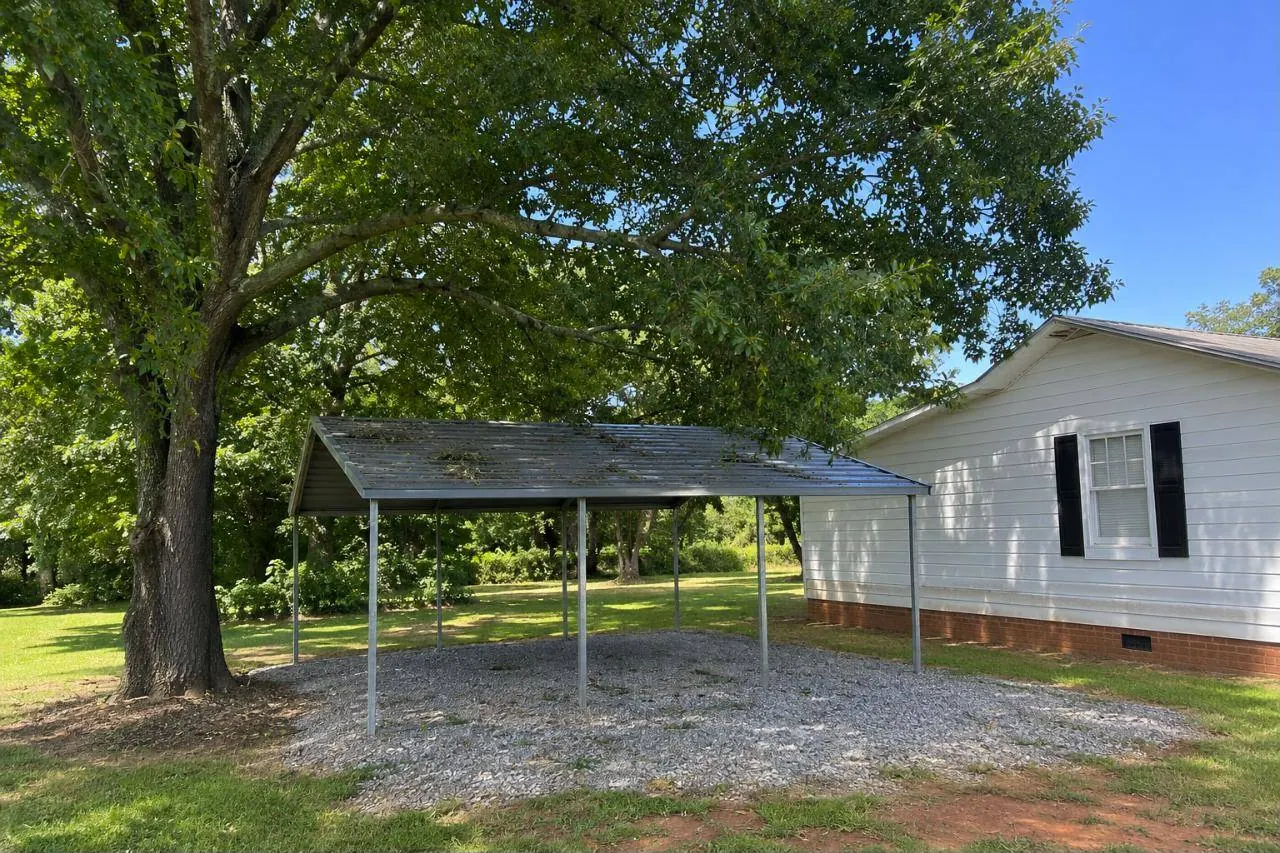
- Clear the roof and carport. Limbs that rest on shingles or metal roofing scrape in the wind, and leaves and twigs pile into gutters.
- Lift the canopy. Raise the lowest limbs over the driveway, the mower path or the road so trucks and people pass under.
- Take out dead and hanging wood. South Carolina's Attorney General urged homeowners in January 2026 to remove dead, diseased or hanging branches that could turn into dangerous projectiles in a storm.
- Shape a young tree. Choose the branches that will become the tree's framework while they're small.
Write the goal into the price, in plain terms: clear the carport roof by a set distance, raise the limbs over the drive to a set height, remove all dead wood larger than a set size.
Where a good cut goes
Clemson's Home and Garden Information Center fact sheet on pruning trees (HGIC 1003) sets out the basics that separate a good trim from a damaging one.
- Cut outside the branch collar. The collar is the swollen ring where a branch joins the trunk, and Clemson says it forms a natural barrier against decay. A flush cut that removes it opens the trunk to rot.
- Use three cuts on heavy limbs. For branches over 1½ inches across, the fact sheet calls for an undercut about 15 inches out, a top cut a little farther out so the limb drops cleanly, and a final cut just outside the collar. Skipping the undercut lets the falling limb peel a strip of bark down the trunk.
- Thin rather than shorten. Clemson prefers thinning, removing whole branches back to where they start, over heading branches back to stubs.
- Skip the wound paint. The fact sheet says wound dressings and other pruning agents do not prevent decay, and it doesn't recommend paints or tars.
- Fix narrow forks early. It advises removing branches that form narrow crotch angles, under 45 degrees. NC State Extension adds that the narrower a branch's angle of attachment, the more likely it is to break or split under snow and ice.
How much comes off at once matters too. The North Carolina Forest Service's storm-damage guide for city crews notes that pruning standards call for removing no more than 25 percent of a tree's live crown in a year. Ask how much of the canopy the crew expects to take.
Why topping backfires
Topping means cutting a tree's main stems back to stubs to make it shorter. Clemson's fact sheet on it (HGIC 1024) explains why it so often ends badly:
- It removes the leaves that feed the tree.
- The exposed wood at each stub begins to decay, and the decay can spread into the trunk.
- The sprouts that grow back are anchored only in the outermost layers of the branch, so they're likely to break as they get heavier.
- Bark suddenly left in full sun can scald, leading to cankers and dead branches.
Clemson's bottom line is blunt: severely pruned trees often have to be removed within ten years, and a topped tree is an expense waiting to happen. The Attorney General's January 2026 storm advice says the same thing in fewer words: never allow topping, because it weakens the tree. If a tree is too tall for its spot, Clemson's alternative is to cut a branch back to a side branch at least a third the diameter of the limb being removed, or to take the branch out entirely.
When to trim
For trees that aren't grown for their flowers, Clemson's pruning fact sheet recommends late winter or early spring. Summer pruning is acceptable, it says, but should stop about ten weeks before the first hard frost. Spring bloomers such as dogwood and redbud set their flower buds the year before, so cutting them in fall or winter costs that spring's blooms.
Storm timing points the same way. In the Natural Hazards study of tree-failure deaths, thunderstorm deaths clustered from May through August and snow and ice deaths from December through April. A trim in late winter or early spring, Clemson's preferred window, clears dead and hanging wood before the summer thunderstorms arrive. Once a storm shows up in the forecast, crews book up fast.
The wire to your house
Duke Energy's tree FAQ says the property owner has primary responsibility for keeping the service line to the house clear of trees and vegetation, and that pruning around power lines should be left to qualified professionals. It also says an unqualified person shouldn't work within 10 feet of an overhead line under 50,000 volts. Duke's tree safety page adds that you can ask a Duke technician to disconnect the service drop before a tree near it is pruned or removed, and reconnect it afterward.
The big lines along the road are the utility's job. If a limb is touching a primary line, don't hire it out: use Duke's tree trimming request page, or call Lynches River Electric Cooperative or York Electric Cooperative if one of them is your provider.
How the crew gets up the tree
Climbing spikes punch holes in the bark. That's fine on a tree that's coming down, but the Attorney General's office says to prohibit spikes on trees that aren't being removed, because the wounds can lead to infection. A tree that's staying should be climbed with ropes or reached from a bucket truck. Ask before work starts.
Published trimming prices
Thumbtack's 2026 trimming guide, last updated October 23, puts most jobs nationwide between $402 and $1,158. Its low-end average is $186 and its high-end average $2,456. By the height of the tree:
| Height of the tree | Thumbtack, October 2026 |
|---|---|
| 5 ft. to 10 ft. | $474 to $848 |
| 11 ft. to 20 ft. | $577 to $993 |
| 21 ft. to 40 ft. | $768 to $1,362 |
| Taller than 40 ft. | $1,126 to $1,957 |
None of these are Lancaster County prices. A tall pine or a spreading water oak sits in the top row, and several trees done in one visit, easy access and who hauls the brush all change the number. See what tree work costs.
Trimming mistakes to avoid
- "Just make it smaller." Shrinking a tree all over is usually topping. Name the clearance you want instead.
- Flush cuts. A cut that removes the branch collar leaves an open path for decay.
- Too much at once. Stripping out a big share of the live crown in one visit stresses the tree.
- Spikes on a keeper. Ask how the climber plans to reach the work.
- Brush left behind. Outside the city and town limits there's no curbside pickup; inside them, check the limb rules first.
When trimming won't fix it
A trim can't rescue a tree that's dead, hollow, split or leaning; read dead or leaning trees instead. For a tree you want gone entirely, go to tree removal. And when limbs are caught in the wires along the road, call the utility before anyone else.
Trimming questions
Do I need a permit to trim a tree in Lancaster County?
Generally not, under the current county code, for an existing home lot outside town limits; the county's tree standards are written for development projects. Inside a town, inside a subdivision's tree save area, along a state road, or once the new county code takes effect, ask first.
Can a tree be cut back hard and still be healthy?
Some can tolerate heavy pruning, but Clemson's advice is to thin branches back to their point of origin rather than shorten them to stubs, and the forestry guidance caps live-crown removal at about a quarter a year.
Should limbs over the roof come off before storm season?
Dead and hanging limbs over the house are the first to go. Late winter or early spring, by Clemson's timing advice, gets the work done before the summer thunderstorms.
Can I cut my neighbor's limbs that hang over my yard?
That's a matter between neighbors, and this site doesn't give legal advice. Talk to the owner first, especially if a cut could damage or kill their tree.
Your request goes to a single independent contractor in the Lancaster area. This site trims nothing itself.
- Clemson Cooperative Extension, Home and Garden Information Center: Principles & Practices for Pruning Trees (HGIC 1003, revised October 2019); Topping Trees (HGIC 1024, 2005).
- NC State Extension, Preventing and Managing Ice and Snow Damage to Landscape Plants (2026). North Carolina Forest Service, Storm-Damaged Tree Assessment: Best Management Practices.
- South Carolina Attorney General, tips for dealing with downed trees and limbs, January 23, 2026.
- Duke Energy, Trees and Rights-of-Way FAQ; Trees and Safety. Lancaster County, Utilities. Schmidlin, Natural Hazards 50 (2009).
- Thumbtack, tree trimming cost guide, updated October 23, 2026.