
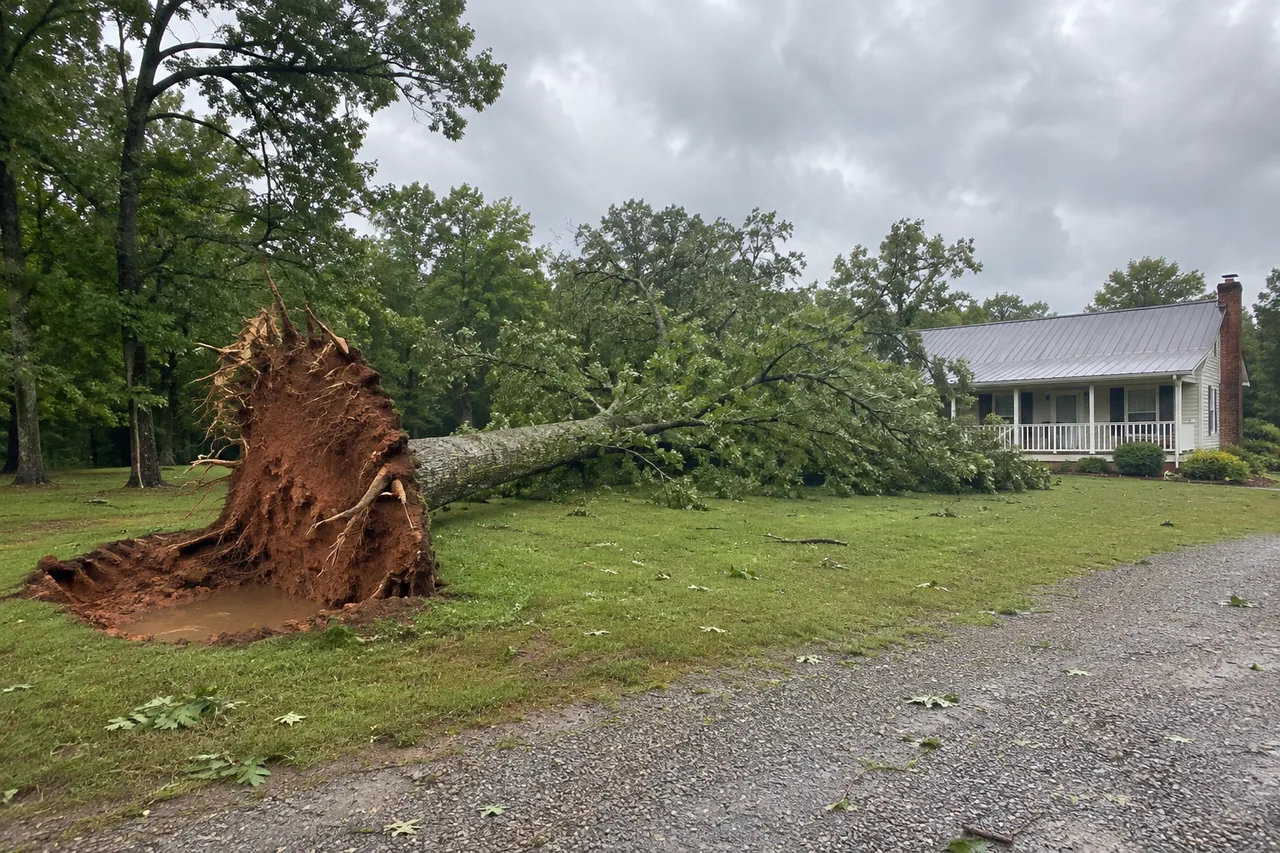
Why a fallen tree is an emergency
Trees kill people in windstorms, and most often on the road. Thomas Schmidlin's study in Natural Hazards found 407 deaths in the United States from wind-related tree failures between 1995 and 2007. Forty-four percent of those people were in a vehicle that a tree struck or that ran into a tree lying across the road, 38 percent were outside, and the remainder split evenly, 9 percent apiece, between mobile homes and frame houses. Deaths in thunderstorms clustered from May through August, and deaths in snow and ice storms from December through April.
Ice storms have hit Lancaster County hard. In the ice and snow storm of February 12–13, 2014, the State Climatology Office recorded 8 inches of snow at Lancaster; statewide, 346,000 homes lost power, five deaths were blamed directly on the storm, and the Forestry Commission put timber damage at $360 million. On January 16, 2022, the same office reported an ice storm warning for parts of the state near and between Interstates 20 and 85, and up to half an inch of ice inside the warned area. Hurricanes can reach this far inland as well. On the night of September 21, 1989, the National Weather Service in Columbia sent a Hurricane Hugo statement to Lancaster and other South Carolina counties warning that the wind could bring down large limbs and uproot trees across roads, and South Carolina Public Radio's 2019 look back recalls acres of felled and broken trees across York, Chester and Lancaster counties.
First steps when a tree comes down
- Get everyone out from under it. A trunk lying on a roof can shift as the wind keeps blowing or as limbs are cut, and it can come through the ceiling.
- Treat every wire as live. Duke Energy tells customers to stay away from fallen or sagging lines and to consider all lines energized, along with any trees or limbs touching them. Duke Energy customers in the Carolinas report outages at 800.POWERON (800-769-3766). If Lynches River Electric Cooperative or York Electric Cooperative serves you, use the number on your bill. If anyone is hurt or a wire is sparking, call 911.
- Stay off the downed tree on the road. Report it instead; see the table below for who maintains which road.
- Photograph before anything moves. Shoot the whole tree, where it stood, the roof, siding, fence, carport and vehicles it hit, and any water coming inside.
- Call your insurer. Ask what they need to see before the tree comes off the house.
- Then arrange the removal. Lifting a trunk off a roof without causing more damage is skilled work. Tell the contractor exactly what is resting on what.
Who handles which tree
| Where the tree is | Who to call |
|---|---|
| Across a state-maintained road | SCDOT's Lancaster County maintenance office, (803) 283-3397, or 855-GO-SCDOT (855-467-2368) |
| Across a county-maintained road | Lancaster County Public Works, (803) 283-2101. The county lists tree removal among its maintenance jobs on county roads. |
| On or against power lines | Duke Energy, Lynches River Electric Cooperative or York Electric Cooperative. Duke says it clears trees from its lines, but disposal of the wood and limbs from that emergency work is the property owner's responsibility. |
| From your lot, on your lot or house | You, with your insurer if it hit an insured structure |
| From a neighbor's lot onto your house | Your own insurer first; it may pursue the neighbor's insurer |
The county's Roads and Bridges page says it doesn't maintain SCDOT roads, roads kept by towns or other agencies, or private drives. For a state road, that page points you to SCDOT at (803) 737-1200. If you can't tell who keeps your road, call the county and describe where the tree is lying.
How insurance usually handles fallen trees
The Insurance Information Institute described the usual pattern under a standard homeowners policy in 2010:
- A tree that wind or hail drops onto the house is generally covered for the damage to the structure and its contents. Paying to remove the tree is usually included as well, capped somewhere around $500 to $1,000 by insurer and policy type.
- A tree that misses every insured structure generally leaves you paying for its removal yourself. The Institute did note that some insurers may cover removing one that blocks a driveway or a ramp built for a person with a disability.
- A neighbor's tree that lands on your house is still a claim on your own policy. Your insurer may try to collect from the neighbor's insurer, a process called subrogation, especially when the tree was in poor health or not properly maintained.
South Carolina's Department of Insurance, quoted in the Attorney General's January 2026 storm release, adds three cautions: most policies have maximum coverage limits; if a tree doesn't touch or damage a covered structure, the policy may only pay if the tree becomes an obstacle; and homeowner policies generally won't cover loss caused by negligence or maintenance issues. That last point is why a dead tree left standing for years can become an expensive claim. The same release tells homeowners not to sign documents that assign their insurance benefits to a contractor.
Every policy differs, deductible included. Read your declarations page, ask your agent, and keep every photo and invoice. No contractor can decide what your policy pays.
The brush after a storm
Inside the City of Lancaster, the solid waste FAQ covers leaves and a knuckle-boom truck for bulk items but not limb limits or storm debris, so call Solid Waste at (803) 286-8471 and watch for city announcements after a big storm. Kershaw's yard debris page sets limbs at no more than 5 feet long and 6 inches around, and no more than 10 cubic yards a week. Outside town limits there's no curbside pickup, so ask whether the price includes hauling, chipping or leaving the wood stacked.
Burning storm brush follows the normal rules: a city permit from October through April inside Lancaster, and Forestry Commission notice at 1-800-705-8610 outside town limits. Neither applies while a statewide burning ban is in force. See the rules guide.
Price gouging after a declared emergency
South Carolina's price gouging law, section 39-5-145 of the state code, applies once the Governor declares a state of emergency and stays in force until that emergency expires or is ended. The Attorney General describes it as a ban on unconscionable prices during times of disaster, and says normal price changes aren't gouging. A violation is a misdemeanor punishable by a $1,000 fine, 30 days in jail, or both. To report a suspected case, the Attorney General's office lists scag.gov/price-gouging and (803) 737-3953; include the time, place, business name and address, the price charged, and nearby prices.
What goes wrong after storms
- Cutting before photographing. The insurer may want to see the tree where it landed.
- Working near wires. Lines can be energized even while the power is out at your house.
- Cutting a trunk under tension. A bent pine or a limb pinned under weight can spring back hard when cut. Leave it to an experienced crew.
- Paying everything up front. The Attorney General's office says never pay in full before the work is finished.
- A handshake deal. Get the scope, price and cleanup in writing, even in a hurry.
When this guide isn't the one you need
If the tree is still standing but worries you, see dead or leaning trees. To get ready for the next storm, read tree trimming and Lancaster County trees. Call 911 before anything else if someone is injured or pinned.
Storm questions
Can I saw the trunk off the roof on my own?
Please don't. The weight of a trunk lying across a roof shifts as pieces come off, and one wrong cut can drive it deeper into the house. Let a crew with rigging lift or lower it.
Will my insurance pay to remove a fallen tree?
If wind or hail dropped it onto an insured structure, removal is commonly covered up to a limit, often about $500 to $1,000 in the Insurance Information Institute's 2010 guidance. A tree that fell only in the yard usually isn't, though the state's Department of Insurance says a policy may pay if the tree becomes an obstacle. Check your policy.
The power company cut the tree off the line. Will they haul it away?
Duke Energy says it doesn't clean up tree debris from severe weather; after its crews clear the lines, disposing of the wood and limbs is up to the property owner.
Do I need a permit to remove a storm-damaged tree?
On an existing home lot outside town limits, the county's tree standards generally don't apply. Even inside a development's tree save area, the current code lets emergency removal of storm damage or an imminent hazard go ahead without prior approval. Call County Planning at (803) 285-6005 if you're unsure.
This site forwards each request to one independent contractor in Lancaster County. It does no tree or storm work itself.
- Natural Hazards, vol. 50, pp. 13–25 (2009): Thomas Schmidlin's study of U.S. deaths from wind-related tree failures, 1995–2007.
- SC State Climatology Office, 12–13 February 2014 ice and snow event; weekly South Carolina weather, January 10–16, 2022. National Weather Service Columbia, Hurricane Hugo local statement, 11 p.m., September 21, 1989 (SC DNR archive). South Carolina Public Radio, "When Hurricane Hugo Rocked the Piedmont" (2019).
- Duke Energy, Trees and Rights-of-Way FAQ; Trees and Safety; storm safety article (2018); Winter Storm Fern release, January 22, 2026. Lancaster County, Utilities.
- SCDOT County Offices. Lancaster County Public Works, Roads & Bridges, and directory. City of Lancaster Solid Waste FAQ. Town of Kershaw, Yard Debris.
- Insurance Information Institute, information on insurance for fallen trees, July 22, 2010. South Carolina Attorney General, storm tips release, January 23, 2026; price gouging release, March 2, 2025.