
Check the rules before the saw
Lancaster County's development code is where tree rules for unincorporated land live, and its tree standards are aimed at building projects. The applicability table in Chapter 7 of the current Unified Development Ordinance lists new construction, but sets apart "Single-Family and Two-Family Dwellings on Previously Platted Lots." For an established house on its own lot, that means the county's landscaping and tree standards generally aren't what stands between you and a removal.
Three situations deserve a phone call anyway:
- A tree save area. Developments can set aside tree save areas to earn credit toward their planting rules. The current code says any removal inside one needs prior approval from county planning staff, though trees in poor health can come out with their say-so and emergency removal of storm damage or an imminent hazard doesn't need approval first. If your subdivision has wooded common ground or a marked buffer, ask before cutting there.
- A tree in the road strip. Work inside a state-maintained right-of-way needs SCDOT's permission, which the department grants through an encroachment permit. The Lancaster County maintenance office is at 1730 Pageland Highway, (803) 283-3397.
- A home inside a town. The City of Lancaster, Heath Springs, Kershaw and Van Wyck are separate governments. The city pages read for this site show no permit for removing a tree on a private home lot, but call City Hall at (803) 283-2489 before taking down a big tree near the street.
The county has also been replacing its development ordinance. Ordinance 2026-2059 passed first reading in September 2026, and the county's FAQ on it says tree preservation applies to "some developments." Ask County Planning at (803) 285-6005 whether the new code is in force and whether it touches your lot. The rules guide goes through each office.
How a tree comes down beside a house
On a rural lot with open pasture beside it, a tree can often be dropped in one piece. In a neighborhood, or anywhere near the house, the shed, the well house or a metal carport, the plan changes. Crews pick from three basic methods, and the choice drives both the price and the risk.
- Felling. The cutter makes a notch on the side the tree should fall toward and a back cut on the other, and the trunk drops along that line. It needs a clear lane longer than the tree is tall, and it's the fastest way down.
- Sectional removal. Where there isn't room to fell it, a climber or a bucket truck takes the limbs first and then the trunk in short lengths. Pieces over a roof or fence are tied off and lowered on ropes rather than dropped.
- Crane removal. A large tree leaning over a house with no safe place to land the pieces may be lifted out section by section. Whether a crane can set up depends on the driveway, soft ground, the septic field and the overhead wires.
Ask which method the crew plans to use and exactly where each piece will land. A good answer names the drop zone and what protects anything inside it.
What happens to the logs and brush
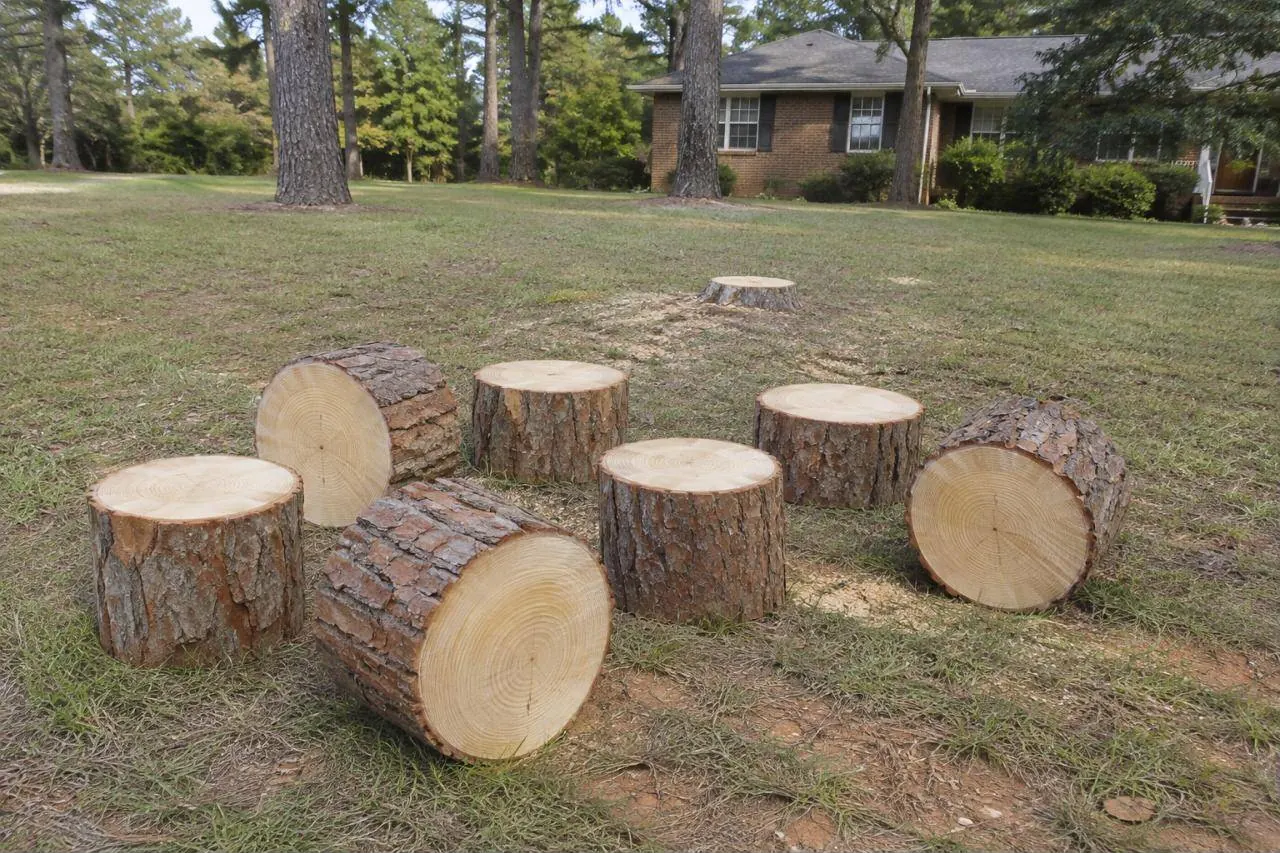
A tall oak or pine leaves a surprising amount behind: trunk rounds, heavy limbs and a mound of brush. Where it goes depends on where you live and what you ask for.
- Inside the City of Lancaster. The city's solid waste FAQ describes a knuckle-boom truck for bulk items and a leaf season that usually runs mid-November to mid-March, but it doesn't give limb sizes or say whether a tree crew's debris will be picked up. Ask Solid Waste at (803) 286-8471 before planning on it.
- Inside Kershaw. The town's yard debris page says tree limbs must be cut into lengths no longer than 5 feet and no bigger than 6 inches around, with no more than 10 cubic yards of limbs and brush set out a week. Limb pickup runs Mondays and Tuesdays.
- Outside town limits. There's no curbside pickup to count on, so the brush is chipped, hauled off, or burned under the state's rules.
Burning has its own calendar. The city's Fire Department issues burn permits that are good from October 1 through April 30 and allows no burning from May through September. Outside town limits, state law requires notifying the SC Forestry Commission first, and the Lancaster County line is 1-800-705-8610. The rules guide covers both.
Whatever you choose, get it in the written price: everything chipped and hauled, brush chipped and logs left in firewood lengths, or chips left in a pile for your beds.
Trees near power lines
Duke Energy's tree FAQ says pruning around power lines "should only be attempted by qualified professionals," and that an unqualified person shouldn't work within 10 feet of overhead lines carrying less than 50,000 volts. The service line running from the pole to your house is a separate case: Duke says the property owner has primary responsibility for keeping it clear. Before a tree beside that line is cut, you can ask Duke to disconnect the service drop and reconnect it when the work is done.
Parts of Lancaster County get power from Lynches River Electric Cooperative or York Electric Cooperative instead. Check the name on your bill and call that provider before any tree near a line comes down. Mention the wires when you send a request, too, because it changes who can do which part of the job.
The stump
Unless the price says otherwise, a removal leaves a stump a few inches above the ground. Many owners have it ground out at the same visit. Grinding cuts below the surface, so submit an SC811 locate request first; SC811's homeowner page asks for it at least three business days before digging, not counting the day you file, weekends or holidays. More on stump grinding.
Where removals go wrong
- No plan for the landing zone. A tree that comes down on the carport or the well house costs far more than the removal.
- Assuming nobody else has a say. Tree save areas, road strips and town limits are the exceptions to the county's usual hands-off approach to home lots.
- Burning in the wrong month. Inside the city, May through September is closed to burning, and statewide bans can close the rest of the year on short notice.
- Buried lines and septic parts. SC811 marks public utilities, not your own water line to a barn, a drainfield or a buried electric run to a shop. A private locating service can mark those, or you can show the crew where they are.
- Nothing in writing about cleanup. Without it, the log pile in the yard may stay yours.
Published removal prices
In Thumbtack's national guide, last updated March 24, 2026, felling and removing a single tree typically costs $450 to $1,450; take the stump out too and the typical range becomes $884 to $1,627. It sets prices by trunk diameter and canopy spread. A trunk under 12 inches with a canopy under 30 feet across runs $226 to $596; a 24- to 36-inch trunk under a canopy wider than 30 feet runs $1,562 to $4,117. These are national averages, not Lancaster County prices. Every figure is on what tree work costs.
Other guides that may fit better
A sound tree that's merely crowding the roof or the driveway may only need a trim (tree trimming). One that a storm has already dropped onto the house belongs under storm and emergency removal. If you're clearing acres of woods for a new house or pasture, that's land clearing, with its own stormwater and burning rules. And if the tree is a tall pine near the house, the pine guide goes further.
Removal questions
Does Lancaster County require a permit to remove a tree from my yard?
The county pages read for this site don't list a tree removal permit for an existing home on a platted lot. Call County Planning at (803) 285-6005 if your lot is in a tree save area or you're unsure.
How close to the house is too close for felling?
If the tree is taller than the open ground between it and the house, felling it whole is off the table, and it has to come down in pieces. The contractor will look at the lean, the limbs and the space before deciding.
Can I keep the wood for firewood?
Usually, yes. Ask for the trunk cut into stove lengths and left, and the price may drop because less has to be hauled.
Who handles a tree on the edge of a state road?
Work inside SCDOT's right-of-way needs the department's permission. Call the Lancaster County maintenance office at (803) 283-3397 before anyone cuts it.
Requests sent from this site reach one independent contractor near Lancaster. The site itself cuts no trees.
- Lancaster County Unified Development Ordinance, Chapter 7, General Development Standards (sections 7.1.1 and 7.1.2); 2026 Unified Development Ordinance FAQ. Read November 2026.
- WRHI, "Lancaster County Council Approves First Reading Of Development Code Rewrite," September 3, 2026.
- SCDOT, Encroachment Permits and County Offices pages. City of Lancaster, Fire Department and Solid Waste FAQs. Town of Kershaw, Yard Debris.
- SC Forestry Commission, Fire and Burning, and How to Notify. Duke Energy, Trees and Rights-of-Way FAQ; Trees and Safety. Lancaster County, Utilities. SC811, Homeowners and Private Lines.
- Thumbtack, cost to remove a tree, updated March 24, 2026.