
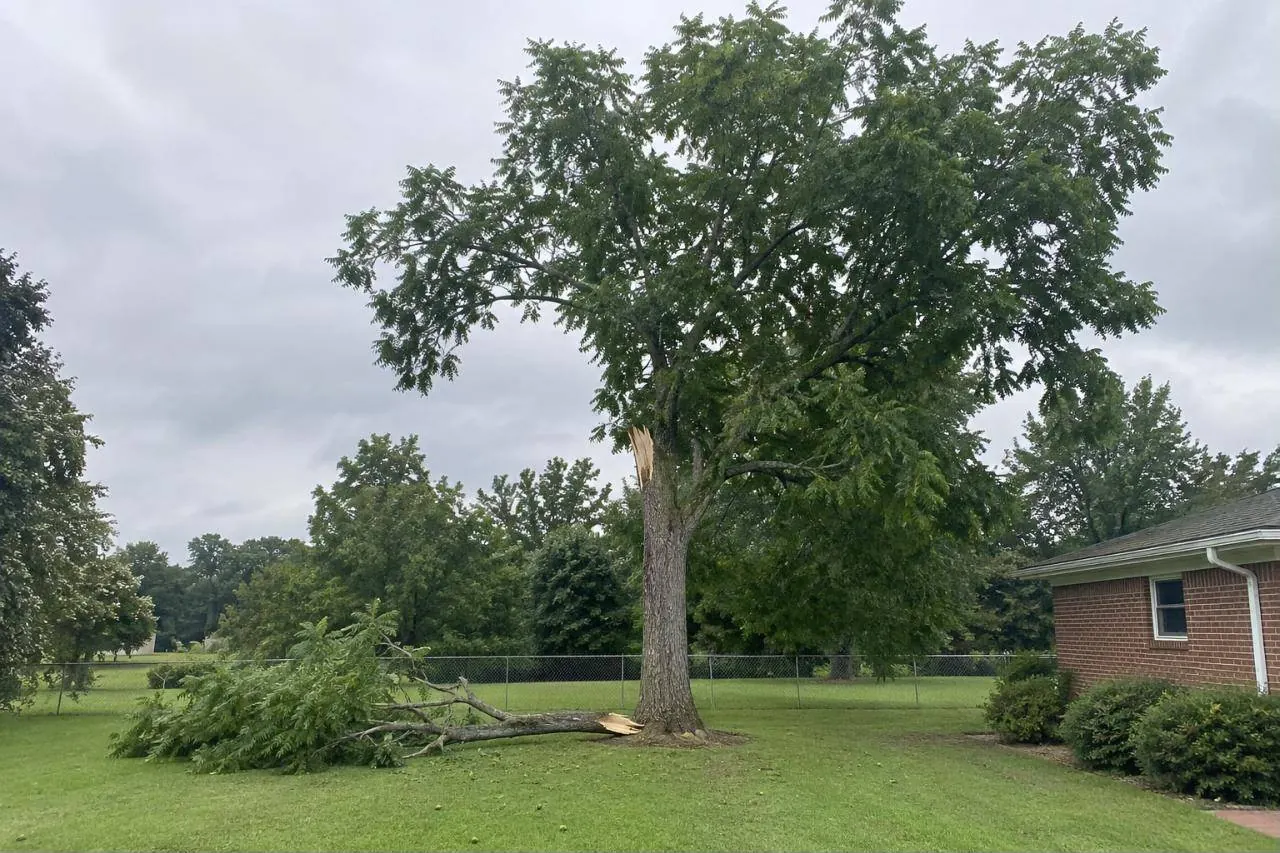
Yard trees at a glance
| Tree | Size | What the experts flag |
|---|---|---|
| Loblolly pine | 90–110 ft at maturity | Short, stout taproot in clay; windthrow common on shallow soils; severely attacked by southern pine beetle (USDA Forest Service) |
| Water oak | 50–60 ft tall and wide | More weak-wooded than most oaks; prone to wind, snow and ice damage; trunks often rot by age 50 (Clemson) |
| Willow oak | 60–75 ft tall, 40–60 ft wide | A few significant problems, including root rot in small urban spaces (Clemson) |
| White oak | Not listed | Can live several hundred years (Clemson); recommended by NC State as a sturdier choice |
| Pecan | Usually 70–100 ft | Brittle branches prone to breakage, especially in wind (NC State); sudden summer limb drop (UF/IFAS) |
| Sweetgum | 60–100 ft | Shallow root system; wood rot among the diseases that may occur (NC State) |
| Bradford pear | Not listed | Narrow branch angles make trees split in half, especially in ice and storms; life span 15–25 years (Clemson) |
NC State Extension's 2026 guide to ice and snow damage names Bradford pear, water oak, pecan, silver maple, green ash, willow, lacebark elm and Leyland cypress as weak-wooded trees more likely to be damaged in wind, snow and ice, and calls Bradford pear the classic example of a weakly structured tree that destroys itself in winter storms.
Water oak: fast, then fragile
Clemson's oak fact sheet explains why a big water oak near the house deserves attention. It grows fast, about 25 feet in 10 years, to 50 or 60 feet tall and wide. But it is more weak-wooded than most oaks, prone to wind, snow and ice damage, and doesn't resist decay well. Its trunks often rot by the time the tree is 50 years old. Its shallow, spreading roots compete with the lawn, and it's subject to galls, leaf spots, scale insects, borers and heavy mistletoe.
A big, old water oak over the house that shows a cavity, fungus at the base, or dead limbs high in the crown is the tree most worth having looked at before storm season. See dead or leaning trees.
Willow oak and white oak
Willow oak, with its narrow, willow-like leaves, is a different story in Clemson's account. It grows 60 to 75 feet tall and 40 to 60 feet wide, about 25 feet in 12 years, and has only a few significant problems: root rot in small urban spaces, borers, orange-striped oakworm, trunk canker and iron chlorosis. A healthy willow oak is often a tree to prune and keep.
White oak is the long game. Clemson says it can live several hundred years, and NC State lists it among the sturdier trees to plant instead of weak-wooded ones. If you're replacing a water oak or a Bradford pear, it's a candidate to ask about.
Loblolly pine
The U.S. Forest Service profile of loblolly pine describes a tree 90 to 110 feet tall at maturity, whose taproot runs 4 to 5 feet deep in sandy or loamy soil but stays much shorter and stouter in clay. It calls the species relatively windfirm on deep soils and says windthrow is common on shallow ones. It also says loblolly is severely attacked by the southern pine beetle, and the Forest Service's South Carolina forest health report for 2002 called that year's beetle activity the worst recorded in the state, heaviest in the foothills and Piedmont. More on pine tree removal.
Pecan: heavy limbs, brittle wood
Pecans are prized for their nuts and shade, and they get big: NC State Extension says they usually grow 70 to 100 feet tall and can reach 130. Its plant profile also says pecans are known for brittle branches prone to breakage, especially in wind. University of Florida Extension's pecan fact sheet adds that branches are sometimes rather brittle and break toward the base, that well-spaced limbs are better attached than clustered ones, and that pecans can suffer sudden summer limb drop, a large branch failing on a very hot summer day with no wind at all. Keep cars, swings and picnic tables out from under heavy pecan limbs that are already cracked or hanging.
Sweetgum
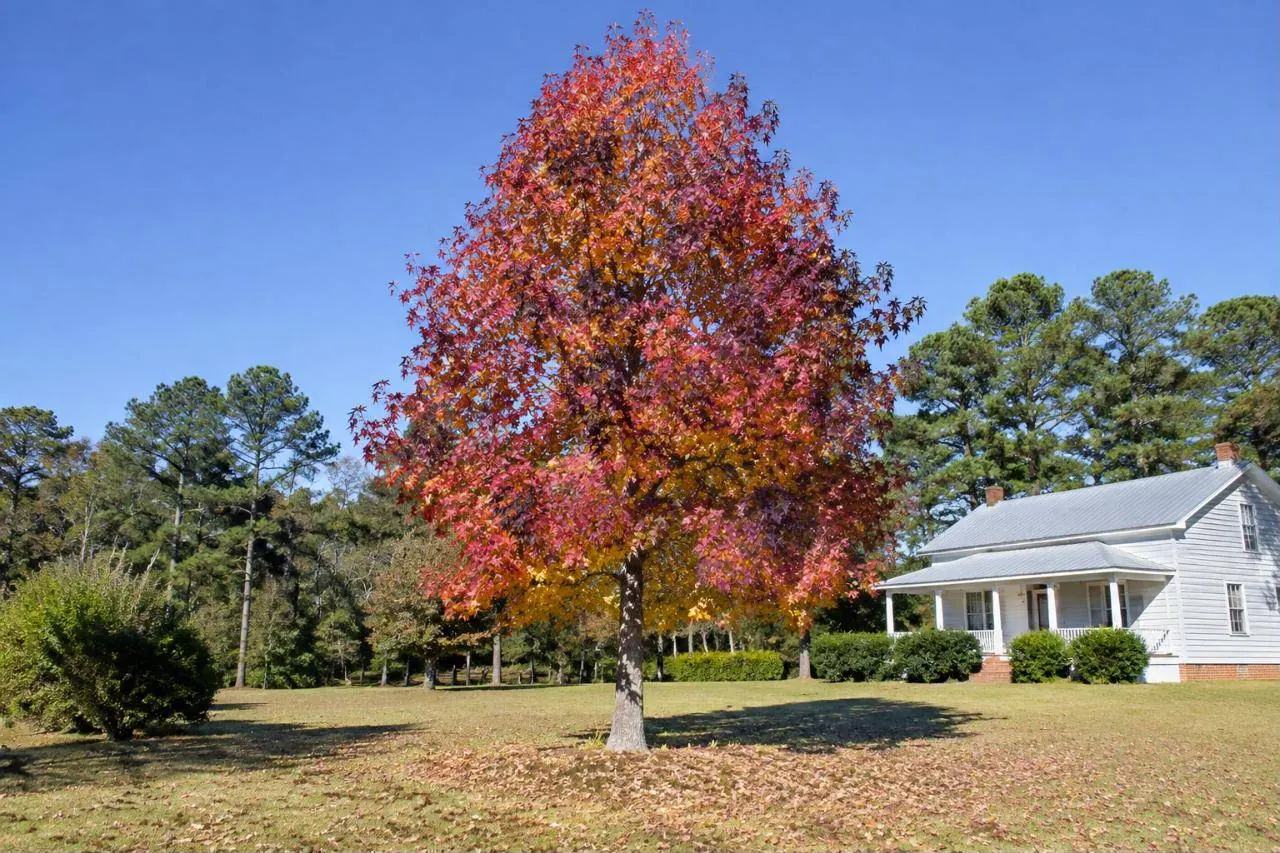
Sweetgum is easy to spot. NC State Extension's plant profile describes leaves with five to seven deep, pointed lobes shaped like a star, autumn color that mixes yellow, orange, purple and red, and spiny "gumballs" that litter lawns and patios. It says the tree may grow 60 to 100 feet tall on a shallow root system, and it lists wood rot among the diseases that may occur. None of the extension sources read for this site single sweetgum out for storm failure, so judge a big one over the house on its own health, lean and limbs.
Bradford pear: the tree that splits
Clemson's Bradford pear fact sheet is blunt: the tree's narrow branching angles cause it to split in half, especially in ice and storms, and the splitting is most severe in trees older than about 15 years. It gives the tree a short to moderate life span of 15 to 25 years.
South Carolina made selling Bradford pear illegal starting October 1, 2024, because the Callery pear rootstock it's grafted onto can grow into thorny trees that cross-pollinate with Bradfords, and birds and deer carry the seed into new areas. Clemson notes the rule doesn't affect trees already growing in your yard, so removing one is your choice. If a Bradford pear stands where it could fall on the house, the car or a play area, it's a strong candidate.
Storms these trees have been through
- Hurricane Hugo, September 1989. The National Weather Service in Columbia warned Lancaster and other counties that night of winds able to drop large limbs and uproot trees across roads. South Carolina Public Radio's 2019 retrospective recalls acres of felled and broken trees and hundreds of downed lines across York, Chester and Lancaster counties.
- Ice and snow, February 12–13, 2014. The State Climatology Office recorded 8 inches of snow at Lancaster; statewide, timber damage was put at $360 million.
- Ice storm, January 16, 2022. The State Climatology Office reported an ice storm warning for parts of South Carolina near and between I-20 and I-85, with up to half an inch of ice in the warned area.
Choosing what to plant next
NC State Extension suggests crape myrtle, bald cypress, hickory, ironwood, ginkgo and white oak as replacements for weak-wooded trees. Whatever you plant, give it room to grow, keep tall trees well away from overhead lines, and shape it while it's young: Clemson's pruning fact sheet advises removing branches with narrow crotch angles early, while the cuts are small.
Questions about local trees
How can I tell a water oak from a willow oak?
Willow oak takes its name from its narrow, willow-like leaves, but young oaks can be hard to tell apart. If it matters for a decision, the contractor or a Clemson Extension county office can help identify the tree.
Should every water oak near the house come down?
Not automatically. Age, size, decay and what's underneath decide it. A young, healthy water oak is a different case from a 50-year-old one with a hollow at the base.
Is it legal to cut down my Bradford pear?
Yes. South Carolina's rule bans selling Bradford pears, not keeping or removing them.
Are pecans safe to keep near the house?
Many are, but their brittle limbs need watching. Have dead, cracked or heavy overextended limbs over the roof or driveway taken out.
Requests sent through this site go to one independent contractor who works in Lancaster County. The site itself does no tree work.
- Clemson Cooperative Extension, Home and Garden Information Center: Oak fact sheet (updated 2024); Bradford Pear fact sheet; Bradford pear sale ban article; Principles & Practices for Pruning Trees (HGIC 1003).
- NC State Extension, Preventing and Managing Ice and Snow Damage to Landscape Plants (2026); Carya illinoinensis and Liquidambar styraciflua plant profiles. UF/IFAS Extension, pecan fact sheet ST122.
- USDA Forest Service, Fire Effects Information System, Pinus taeda; South Carolina Forest Health Highlights 2002.
- National Weather Service Columbia, Hurricane Hugo local statement, September 21, 1989 (SC DNR archive); South Carolina Public Radio (2019); SC State Climatology Office, February 2014 event report and weekly South Carolina weather, January 10–16, 2022.