
Signs a tree may fail
The U.S. Forest Service's guide to hazard tree management (2021) groups the defects that bring trees down into a handful of types. Any of them on a tree that could reach the house, the drive or the road is worth a closer look.
- Dead tops and branches. The guide calls dead trees and dead tops the most obvious and unpredictable kind of tree hazard.
- Cracks. It says cracks in the wood are often a sign that failure has already begun.
- Weak forks. A narrow, V-shaped angle between two stems or branches marks a weak union.
- Decay. Rot inside the trunk shows up as cavities, shelf-like fungus called conks, and soft "punk knots." Conks and punk knots, the guide says, point to extensive internal decay.
- Cankers. Sunken or dead patches of bark where a disease has killed the living tissue beneath.
- Root problems. Roots anchor the tree, and damaged or diseased roots greatly reduce its strength. Exposed or cut roots belong on this list.
Not every flaw means the tree has to come down. Sometimes taking out the damaged part is enough. Have someone who works on trees every day look at it before you decide.
When a lean is dangerous
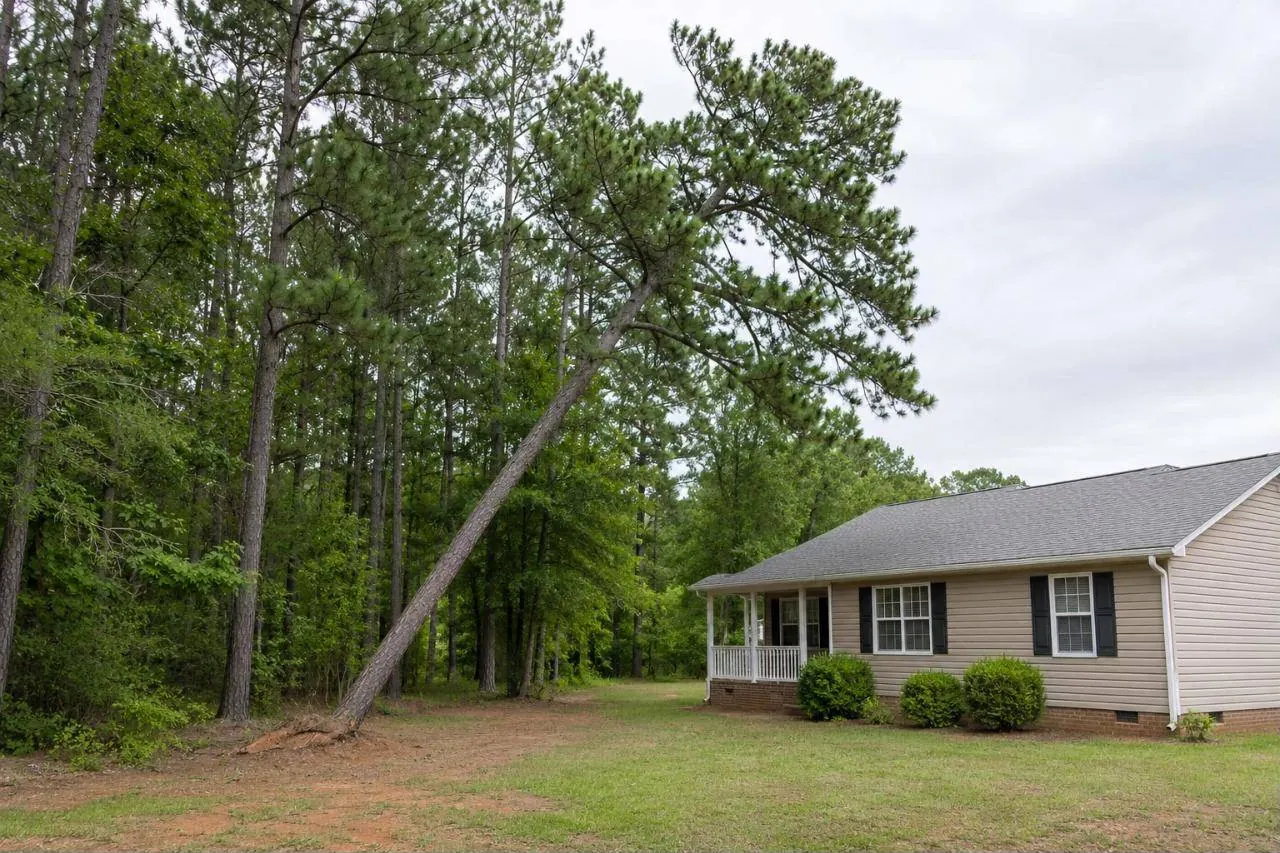
Plenty of trees grow at an angle for decades and stay put. The Forest Service guide separates a natural lean, which is most pronounced at the base and which the tree has adjusted to over time, from an uncorrected lean caused by damage to the roots or trunk. Recent soil movement or soil lifting around the base is a sign of the second kind.
The North Carolina Forest Service's storm-damage guide for city tree crews gets specific. A tree leaning about 30 degrees or more should be inspected closely. Soil mounded up on the side away from the lean, cracked soil and exposed roots are warning signs, and a mound with cracking or movement on the side the wind came from calls for removal. A tall loblolly that has begun to lean toward the house after a storm on wet clay belongs in this group.
Pines that turn yellow, then red
A pine whose crown fades from green to yellow, orange and then red has often been attacked by bark beetles. Clemson's Home and Garden Information Center warns that homeowners tend to notice the color change too late. The signs differ by beetle:
- Southern pine beetle. Small pitch tubes, popcorn-shaped lumps of resin under half an inch across, sometimes covered in brown sawdust.
- Ips engraver beetles. Pitch tubes are less common, but brown boring dust may collect in the bark.
- Black turpentine beetle. Large pitch tubes on the lower 10 to 12 feet of the trunk.
Clemson says the beetles go after trees already weakened or stressed by crowding, drought, disease, soil compaction, equipment damage or lightning. Insecticide labels allow treatments meant to protect neighboring trees, but Clemson notes they work only on healthy trees; a pine already showing signs of attack won't benefit. A dead pine within reach of the house, the carport or the road is a removal to plan soon. See pine tree removal.
Aging water oaks
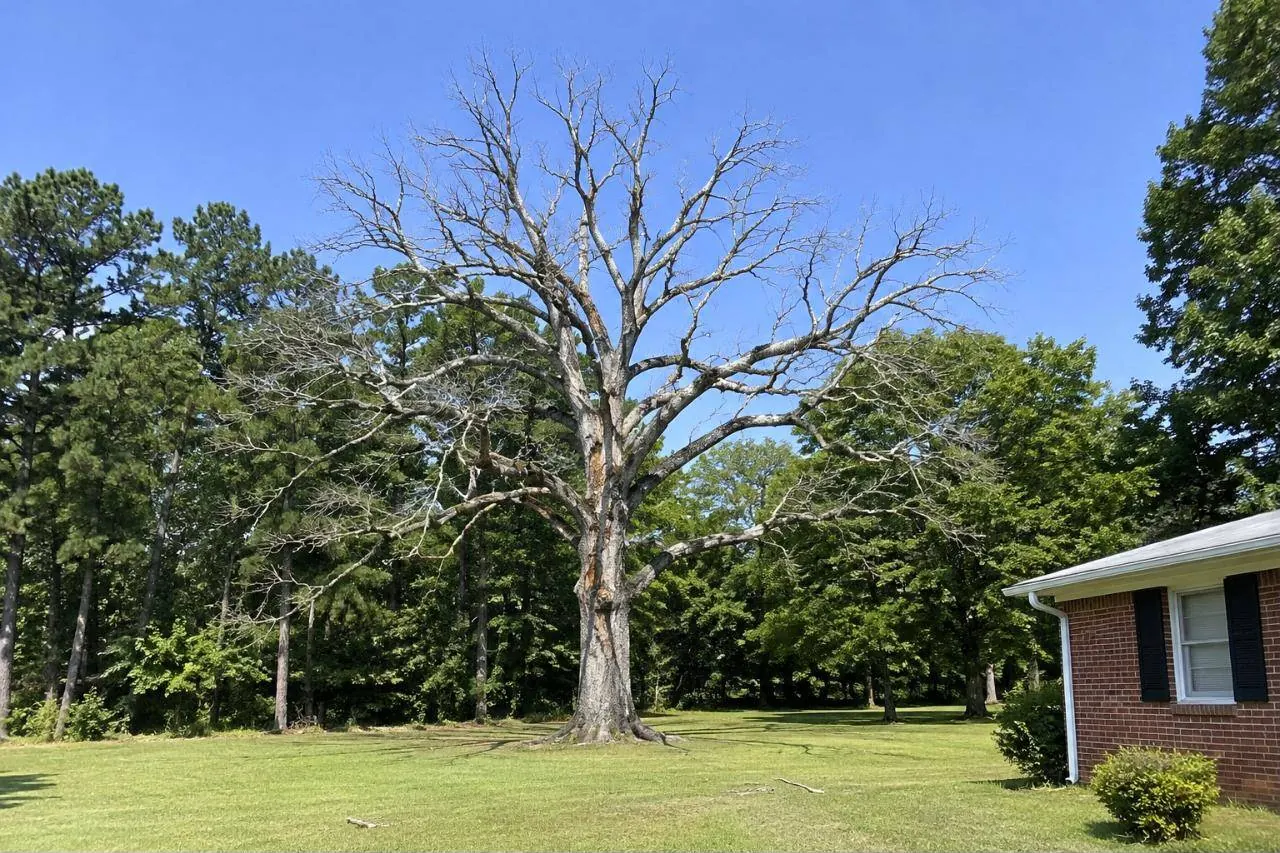
Water oak grows fast, about 25 feet in 10 years by Clemson's count, and that speed has a price. Clemson's oak fact sheet says it is more weak-wooded than most oaks and prone to wind, snow and ice damage, that it doesn't resist decay well, and that trunks often rot by the time a water oak is 50 years old. A big water oak over the house with a cavity, fungus at the base or dead limbs high in the crown is the tree most worth having checked before storm season. NC State Extension also lists water oak among the weak-wooded trees more likely to be damaged in wind, snow and ice.
Pecans are another yard tree to watch. University of Florida Extension describes pecan branches as rather brittle, and notes "sudden summer limb drop," a large limb breaking partway along on a hot summer day with no wind at all. Don't park or set up a picnic table under a heavy pecan limb that's already cracked. More on Lancaster County trees.
After a storm: how much damage is too much?
For trees that came through a storm damaged but standing, the North Carolina Forest Service guide offers a rule of thumb: remove a tree that has lost 50 percent or more of its live crown. It also says broken branches left hanging in the crown, called hangers, should be taken down, and that trees with cracks running into the heartwood, or cracks tied to decay or a cavity, should come out after an inspection. Health, age, size, species and how evenly the crown was lost all weigh in, so a tree just under the line isn't automatically safe.
When the hazard is next door
Talk with the owner first if a dying or leaning tree on the adjoining lot could reach your house. Should it land on your house, a 2010 Insurance Information Institute release says the claim is filed with your own insurer, which may then seek repayment from the neighbor's company, particularly when the tree was in poor health or poorly kept. The state's Department of Insurance, quoted in the Attorney General's January 2026 storm release, adds that homeowner policies generally won't cover loss caused by negligence or maintenance issues. A dead tree on your own lot can count against you the same way.
Photographs help in either direction. The Attorney General's office suggests date-stamped photos of your trees before storm season and keeping every arborist report and invoice for insurance records.
Rules for removing a hazard tree
For an existing house on a platted lot outside town limits, Lancaster County's current tree standards generally don't stand in the way. Inside a development's tree save area, the code lets trees in poor health come out once county planning staff agree, and lets emergency removal of storm damage or an imminent hazard go ahead without prior approval. Ask County Planning at (803) 285-6005 if you're unsure. Inside a town, call the town first. See the rules guide.
Mistakes with dead and leaning trees
- Waiting for one more storm. A lean that's getting worse, or soil heaving at the base, calls for a look right away.
- Judging by leaves alone. A tree can leaf out over a hollow trunk, and a pine's needles often turn color only after the beetles have done their damage.
- Climbing a dead tree. Dead wood is brittle. Ask how the crew plans to bring it down, whether from a bucket, a crane or by felling.
- Cutting it yourself. A leaning trunk carries tension that can split it or kick it back when cut.
Questions about failing trees
My pine went from green to rust in about a month. Is it gone?
A crown that changes color that quickly often follows a bark beetle attack, and by the time the needles are red the tree usually can't be saved. Have it looked at, and plan its removal if it can reach anything you care about.
Is every leaning tree dangerous?
No. A tree that grew at an angle and has stood that way for years may be stable. One that started leaning recently, or shows soil lifting or cracking at the base, is a different story.
The oak didn't leaf out this spring. Should I wait and see?
Don't wait long. An oak whose crown is still bare in midsummer may be dead or dying, and dead limbs over a roof or drive are the first to fall. Have it checked.
Who decides whether a tree is a hazard?
On your own lot, you do, with advice from someone who looks at the tree in person. The Attorney General's office suggests having an arborist check for root rot, decay and structural weakness.
A request from this site goes to one independent contractor in the Lancaster area. The site doesn't inspect or cut trees.
- USDA Forest Service, Hazard Tree Management, Technical Report R2-73 (May 2021). North Carolina Forest Service, Storm-Damaged Tree Assessment: Best Management Practices.
- Clemson Cooperative Extension, Home and Garden Information Center: Oak fact sheet (updated 2024); article on pine bark beetles in home landscapes (2020). NC State Extension, ice and snow damage (2026). UF/IFAS Extension, Carya illinoinensis: Pecan (ST122).
- Insurance Information Institute, fallen trees (2010). South Carolina Attorney General, storm tips release, January 23, 2026.
- Lancaster County Unified Development Ordinance, Chapter 7.