
Removal: the national figures
Thumbtack's cost guide for removing a tree, last updated March 24, 2026, gives a national average range of $450 to $1,450 to cut down one tree. Its low end runs $373 to $432 and its high end $2,500 to $3,300. Taking the stump out as well lifts the usual range to $884 to $1,627. Instead of height, the guide uses trunk diameter and the width of the canopy:
| Crown spread | Trunk up to 12 in. | Trunk 12–24 in. | Trunk 24–36 in. |
|---|---|---|---|
| Up to 30 ft. across | $226–$596 | $517–$1,364 | $976–$2,573 |
| Past 30 ft. across | $359–$946 | $808–$2,132 | $1,562–$4,117 |
The table stops at 36 inches. A bigger trunk, such as an old water oak or a pecan that has been growing for generations, sits beyond the published tiers.
Trimming: the national figures
For pruning, Thumbtack keeps a separate guide, last revised October 23, 2026. Most trimming jobs nationwide land between $402 and $1,158, its averages at the cheap and expensive ends being $186 and $2,456. By height, a tree of 5 to 10 feet costs $474 to $848 to trim, and one taller than 40 feet costs $1,126 to $1,957. The full table is on tree trimming.
Stump grinding: the national figures
The March 2026 removal guide also prices grinding by itself, once the tree is already down. The smallest stumps, under a foot across, cost $267 to $354; the biggest in the table, 36 to 48 inches, cost $372 to $494. Stumps between those sizes fall in between, from $324 to $486. More on stump grinding.
Worked example: a water oak over a one-story house
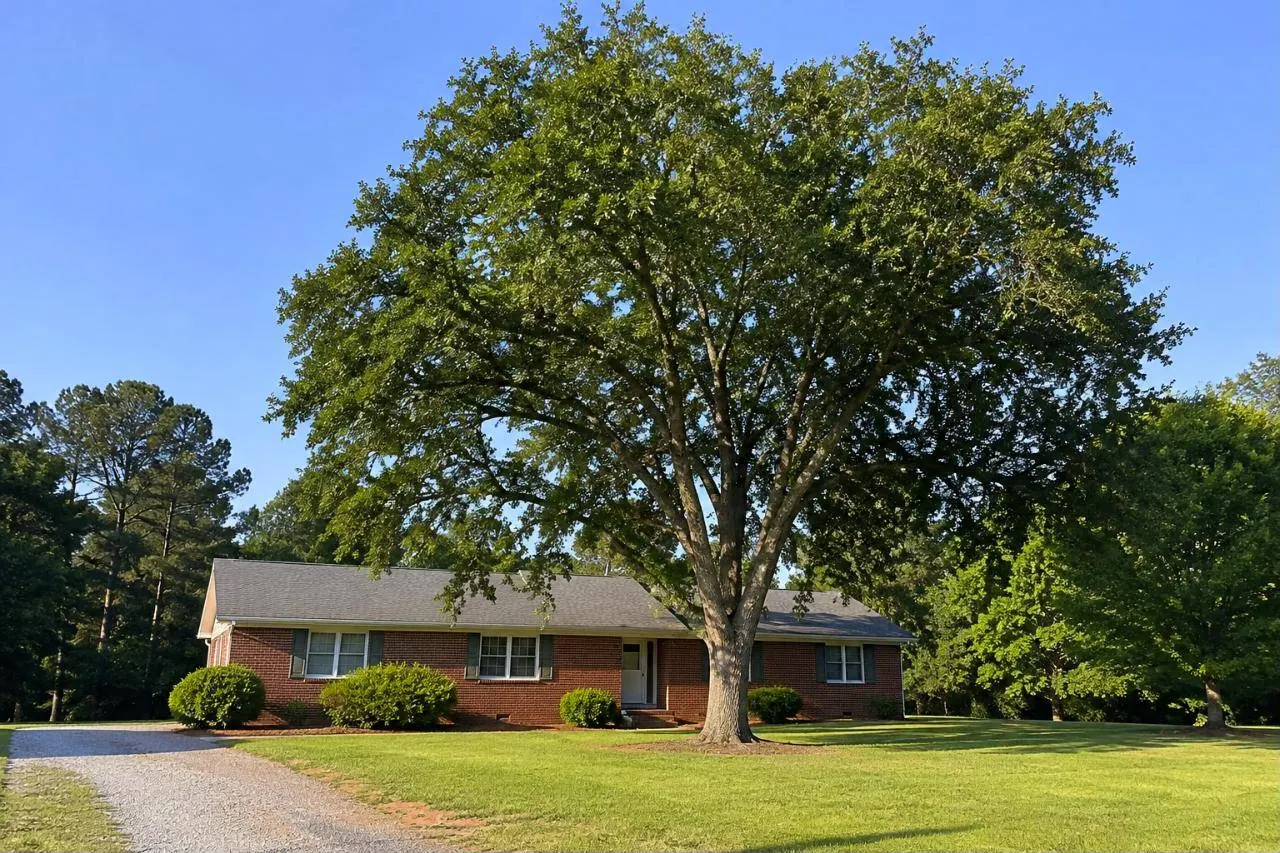
Say the tree is a water oak with a trunk about 22 inches across at chest height and a crown about 40 feet wide, standing in the front yard, and you want the stump ground.
- Taking the tree down (trunk in the 12-to-24-inch tier, crown wider than 30 feet): $808 to $2,132.
- Grinding a stump in that same size tier: $324 to $443.
- Add the two national tiers and the job lands at $1,132 to $2,575.
That assumes ordinary access and a place to drop the pieces. If the limbs hang over the roof and have to be roped down, expect the top of the range or beyond it. If you keep the logs for firewood, the hauling part of the job shrinks.
What moves a Lancaster County price
| Factor | Why it matters here |
|---|---|
| Trunk and canopy | Thumbtack's ranges climb steeply from its smallest trunk tier to its largest |
| What's underneath | A roof, carport, shed, well house, fence or wires below means limbs and trunk sections are lowered on ropes |
| Getting equipment in | A tree behind the house, across soft clay after rain or past a septic drainfield limits where a truck or loader can drive |
| Lean and condition | A dead or leaning tree, or a pine with beetle damage, can't be climbed or cut the same way as a sound one |
| Wood and brush | Inside the city and towns, limb pickup rules vary; outside them, there's no curbside pickup, so hauling or chipping is part of the job |
| The stump | Ground at the same visit or left; grinding is priced by diameter |
| Wires | Work near the service line may need Duke Energy or the co-op to disconnect it first |
| Storm damage | A tree on a roof or tangled in a fence is slower and riskier than a standing tree |
| Several trees | Doing more than one tree in a visit spreads the cost of bringing the crew and machines |
Insurance and fallen trees
In a 2010 release, the Insurance Information Institute explained that when wind or hail knocks a tree onto an insured structure, a standard homeowners policy generally covers the damage, and usually covers removing the tree too, capped at roughly $500 to $1,000 by insurer and policy type. If nothing insured was hit, removing the debris generally isn't covered. South Carolina's Department of Insurance adds that homeowner policies generally won't cover loss caused by negligence or maintenance issues, which is one more reason not to leave a dead tree standing. See storm and emergency removal.
What the written price should list
- Each tree, by where it stands and what kind it is, with its rough trunk size.
- How it comes down: felled, taken down in sections, or lifted with a crane.
- The stump: ground or left, and if ground, to what depth.
- Brush, logs and chips: which ones go and which stay.
- Who files the SC811 ticket before grinding.
- How the lawn, drive, septic area and whatever sits under the tree will be kept from harm.
- The full price, any money up front, and the date the rest comes due.
Cost questions
Why doesn't this page show a Lancaster County price?
No local contractor's prices were gathered for this site, and this site found no public record of what tree jobs cost here. The national figures are a starting point; the contractor's written price is the local number.
Does a bigger tree always cost more?
Usually, but what's under it can matter just as much. A tall pine in an open field may cost less than a smaller oak hanging over a metal carport.
Is there a county or city permit fee to add?
The county and city pages read for this site don't list a tree removal permit for an existing home on a platted lot. A burn permit in the city comes from the Fire Department without a fee. See the rules guide.
Will keeping the wood lower the price?
Often. Hauling is part of the cost. Ask for the price both ways.
This site connects each request with one independent contractor in the Lancaster area. Prices come from that contractor, not from this site.
- Thumbtack's removal cost guide ("How much will your tree trimming and removal cost?"), last updated March 24, 2026, and its 2026 Tree Trimming Cost Guide, last updated October 23, 2026.
- Insurance Information Institute, insurance for fallen trees, July 22, 2010. South Carolina Attorney General, storm tips release quoting the Department of Insurance, January 23, 2026.
- City of Lancaster Fire Department and Solid Waste FAQs; Town of Kershaw, Yard Debris; Lancaster County Unified Development Ordinance, Chapter 7.